The Zelinger Company Story:
It All Started With a Door Handle
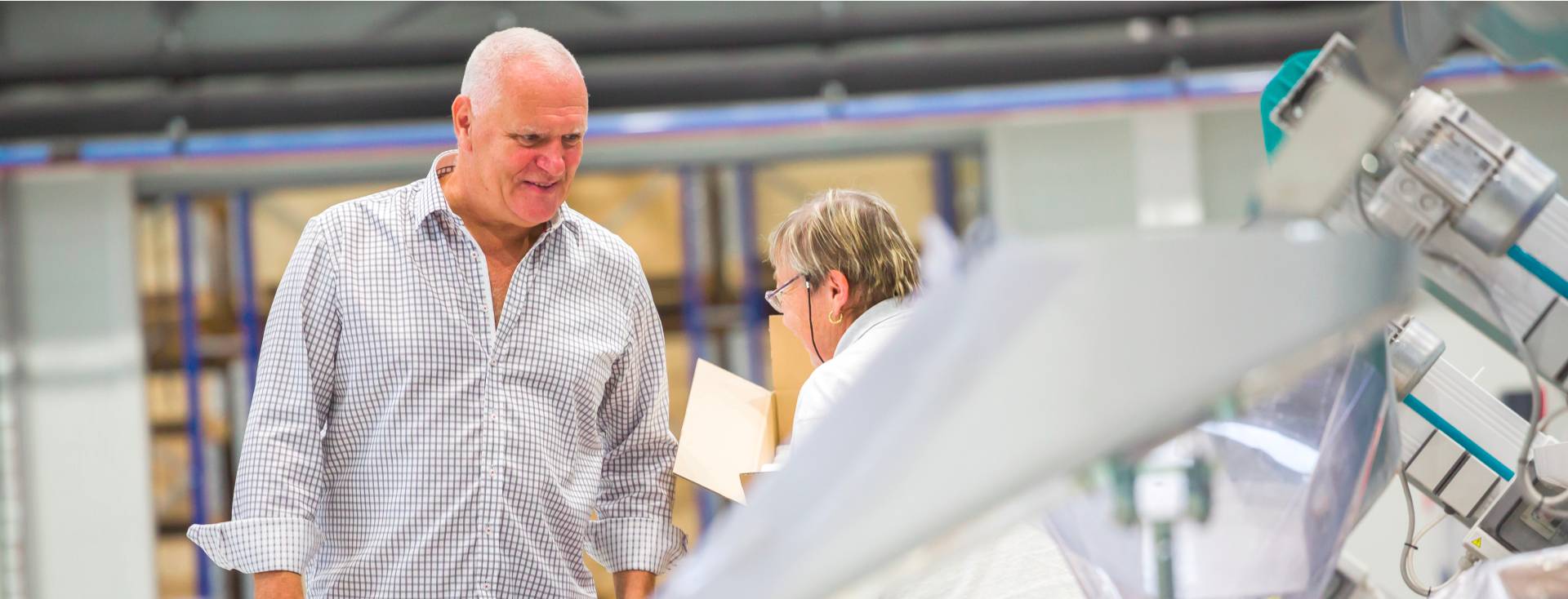
He started with one salvaged press, now he produces a billion parts a year in a new modern hall.
Zelinger products can be found in almost every household, spanning practically the entire globe. As a key supplier to furniture giant IKEA, as well as partners for Honeywell and Shimano, the company produces nearly a billion plastic components annually at its modern facility in Tečovice—on the site of a former soda bottling plant.
Lubomír Zelinger’s entrepreneurial journey began thirty years ago. "I knew I wanted to manufacture door handles, but I had zero experience. I bought an old machine from a scrapyard; I would press the handles in the morning, pack them in the afternoon, and deliver them the next day in a beat-up old Lada," the owner recalls. Today, he leads a thriving enterprise equipped with dozens of state-of-the-art machines and a workforce of nearly a hundred employees.
"We must constantly remind ourselves that nothing in this world remains static. Everything is in motion – ourselves, our environment, our relationships, our health, our mindset, our products, and our work. Everything evolves. Things either improve or decline; there is no middle ground. Stagnation is simply another form of deterioration. Every moment not spent on improvement works against us. Let us, therefore, strive to ensure things are always getting better.
— Lubomír Zelinger, Company Owner
How did you get into the plastics industry?
I wasn’t exactly a star student in elementary school; my interests lay elsewhere. I headed to a vocational school, and because my father told me that chemistry was the field of the future, I chose rubber and plastics. That’s where I discovered that learning didn't have to be a struggle. In fact, I started to enjoy it. I went on to graduate from a technical high school and, after completing my military service, I earned a degree from the Faculty of Technology in Zlín.
I was already working at Barum in Otrokovice during my studies. Later, I took a job as a quality inspector and then as a technologist at what was then the 'Rudý říjen' plant. In 1985, I moved to the general directorate of the Czech Rubber and Plastics Works in Louky. I was responsible for twelve plants across the country, including major names like Fatra, Mitas, Rubena and Rudý říjen. My job was to travel and oversee their operations. To be honest, I didn't find it very fulfilling, but it was a well-paying position.
When did you decide to go out on your own?
When we jingled our keys in the streets in 1989 to mark the end of the regime, I started thinking about my next move. Opportunities to privatize various state companies were opening up everywhere, but that didn't interest me. I wanted to build something from scratch and see if I could make it on my own. I considered several different products, and then it hit me: the door handles available on our market back then were just plain ugly.
Why door handles specifically?
When my daughter was little, she ran into the sharp edge of a door handle and cut her face. That was the moment I realized there was a need for safer designs. At that time, the selection on our market was abysmal – and not just for handles. I managed to get a sample of a curved plastic handle, took a leap of faith, and quit my job.
What were those early days like?
I had no idea what I was getting into. Imagine your steady paycheck suddenly disappears, and you’re entirely on your own. It was incredibly tough – like being thrown into the deep end when you don’t know how to swim. I knew I wanted to make door handles, but I had zero experience. I had to start from absolute zero: find a workspace, source equipment, and most importantly, find the money. I had exactly 800 crowns in my savings, which isn't exactly enough to launch a business.
I took out a bank loan, put up everything I owned as collateral, and bought a decommissioned press from a scrapyard. I devoured every book I could find on plastics, while friends helped me build the molds. Then, I just started. I’d spend the morning molding the handles, the afternoon packing them, and the next day I’d head out to sell them. Everything was hauled in the trunk of my old Lada. Those early days were a wild ride, but I loved every minute of it. It stayed like that for about a year.
Was it difficult to break into the market?
The times were wild, but on the other hand, the market was a complete vacuum. If you produced white flower boxes at a time when only brown ones were available, people would practically snap them up instantly. It was the same with door handles. However, setting up distribution was a nightmare; the old household goods retail networks had collapsed, and modern wholesalers didn't exist yet. There were no big-box DIY retailers like OBI or Baumax back then.
We also faced many other difficulties – there were no computers, no established business expertise, and almost no one knew how to actually run a company. The rules hadn't been written yet, and the government was struggling to keep up with the rapidly changing environment.
I assume you didn’t stop at just one machine…
I earned my money back bit by bit. At the time, we were operating a single machine in a makeshift wooden shack in Otrokovice, right at the main intersection where Lidl stands today. Within six months, however, that machine had paid for a second one. I managed my finances prudently to avoid getting too deeply into debt. We stuck with door handles but started expanding our range to include coat hangers and other household accessories.
As production grew, we eventually needed more space for our equipment. We moved to a site by the Dřevnice River in Malenovice, where we renovated the halls, added more machinery, and gradually grew our team.
So you expanded your range – it wasn't just about door handles anymore?
Mainly, we realized that building and sustaining our own brand in the market was incredibly demanding; it requires significant capital and the right connections. I had to decide whether to continue down that path or pivot to becoming a contract manufacturer for other brands. We got a chance to pitch our production capacity to the IKEA plant in Malacky, Slovakia. Meeting the rigorous standards of a major multinational was no small feat, but we succeeded.
That first order opened the door to many more. It was a gradual process, as large retail chains are extremely selective when choosing their partners. As we added more multinational clients, our turnover grew, allowing us to invest in new machinery and eventually plan for a brand-new facility, as our existing one had simply run out of room for expansion.
Was that when you moved to the current site in Tečovice?
Actually, it was our customers who drove that decision. The site of a former soda bottling plant in Tečovice became available, but nothing on the property was usable for our needs. With the help of grant funding, we completely transformed the site. I’m incredibly glad I took the plunge; without this move, the company wouldn't have had a future. Instead, our production capacity tripled.
Our clients saw firsthand that we were committed to modernizing. It sparked a huge leap forward in terms of turnover and our reputation in the industry. We were even fortunate enough to be ranked as a priority partner for IKEA – a category reserved for their largest and most reliable suppliers, whom they integrate into their long-term global development.
Do you still manufacture any of your own products?
Yes, we still produce door handles. It’s a thirty-year-old design, but it’s still in demand—which is a success in its own right. I’d say almost everyone in this country has held one of our handles at some point. We also used to make toys of our own design that were truly ahead of their time. For example, we had a brilliantly engineered toy car that could be rebuilt into a hundred different variations.
We pitched it to major European retailers and even in the US. They told us it was a fantastic concept, but they were already buying similar toys from Asia by the ton. Competing on that scale would have required a massive amount of capital and energy. Every entrepreneur falls in love with their product, but sometimes that can be counterproductive. You have to know when it’s time to take a different path.
You present Zelinger as a family business. What does that mean to you?
To me, the word “family” represents stability, strength, responsibility, a sense of belonging, and a supportive atmosphere. It is something you can truly rely on. I strive to instill these family values into our corporate culture. Since the company bears my name, it carries a deep sense of personal commitment; you tend to take every success and failure much more to heart. Customers also approach a family owner with a level of trust and connection that you simply don’t find with a hired corporate executive.
**Are members of your family involved in running the company?**
I have two daughters living in Prague—one is a student, and the other has settled there with her family. My son works here at the company. I’ve always been a tough boss to him; I didn't believe in giving him any shortcuts. He had to earn his way up, starting on the factory floor in blue-collar roles. Today, he heads one of our departments, and I’m focused on passing my experience on to him.
Are members of your family involved in running the company?
I have two daughters living in Prague—one is a student, and the other has settled there with her family. My son works here at the company. I’ve always been a tough boss to him; I didn't believe in giving him any shortcuts. He had to earn his way up, starting on the factory floor in blue-collar roles. Today, he heads one of our departments, and I’m focused on passing my experience on to him.
What types of products do you make and for which customers?
Our largest and highest-priority partner is IKEA Components. We manufacture approximately 350 different types of parts for them, all in high-volume series. Another key client is Schott in Valašské Meziříčí, which supplies refrigeration units for the Miele brand. We also collaborate closely with the Japanese multinational Shimano, producing high-precision components for their derailleurs. They are currently transferring production from Singapore to our facility, which we consider a great honor.
Additionally, we supply Honeywell with components for HVAC and air conditioning systems. These are our four cornerstone customers. We also maintain a presence in the automotive sector. Through these global corporations, our parts reach markets all over the world. We don’t aim for a massive portfolio of clients; instead, we focus on being the absolute best strategic partner for the select few we serve.
The Zlín region has a deep tradition in rubber and plastics. Is it still thriving today?
It all began with Tomáš Baťa, the legendary industrialist who insisted on manufacturing everything in-house—from rubber soles to tires. His expansion of the rubber industry drew thousands of people to this region. During the communist era, the infrastructure and the expertise remained, though the enterprises were restructured and renamed. At that time, we benefited from an exceptional technical education system, including vocational schools, specialized high schools, a chemical technology faculty, and a dedicated research institute.
Today, however, technical programs in schools have dwindled, which is a major setback for us. After the revolution, many experts from both industry and academia ventured out to start their own businesses, leading to a surge of new plastics firms in the Zlín area. Major international players like Greiner also moved in. Our biggest challenge now is a critical shortage of skilled labor; the education system simply cannot keep up with demand. The highest need is for machine setters. We are likely approaching the model seen in Germany, where every large company trains its own apprentices. In fact, we are already cultivating our own talent in-house. At this point, there seems to be no other way forward.
So you’re also feeling the shortage of quality personnel?
You can invest in the latest machinery, state-of-the-art buildings, and new technologies, but what is incredibly hard to find are people who truly care—those who are loyal and put their hearts into the company. To fill our blue-collar roles, we supplement our workforce with a few dozen agency staff. I was very selective when choosing an agency; it was vital to me that they treated their people with respect, paid fair wages, and allowed them to maintain their sense of pride. That’s why our agency workers stay in a hotel rather than in some cramped worker hostels.
But our biggest pain point is technical staff, particularly skilled machine setters. In today's market, they are becoming the rarest of professions.
And what about competition from Asia?
The West moved its production to Asia, and with it, we handed over our know-how. People there are incredibly sharp, skilled, and have a profound drive to learn and work. If you haven’t seen China firsthand, it’s hard to grasp. It’s a massive country with enormous domestic consumption. Today, they are moving far beyond mass production; they are highly progressive and capable of manufacturing sophisticated, high-quality products. Of course, you still see rudimentary, almost ‘medieval’ workshops there, but right next to them are facilities so advanced – fully automated and pristine – that we won't catch up to them in a decade.
Competition is intensifying, and it’s getting harder to compete. Europe still likes to see itself as a global leader, but the reality is shifting; China and other Asian nations are rapidly claiming that position. However, labor costs are rising there too, and shipping has become more expensive and unreliable. This is an undeniable advantage that might save Europe. Many multinational corporations are now reshoring their production. If you can match the price while being closer to their European headquarters, you become a much more attractive partner.
You’ve had a new production facility since 2018. But it’s more than just a building – it’s an incredibly precise, optimized production ecosystem…
We had the luxury of not being rushed into construction, which gave us the time to focus on the design phase. We were able to meticulously plan the layout of the machinery and the flow of materials. We built everything on the principles of lean manufacturing—a system designed to eliminate waste in time, material, and energy.
By implementing these principles, we’ve significantly reduced production costs, making us more competitive and more attractive to international buyers. Every stage of the process is seamlessly integrated; it’s highly sophisticated, yet kept as simple and efficient as possible.
How have you navigated the challenges of recent years—COVID-19, the logistics crisis, and the dramatic rise in energy and fuel prices?
Regarding COVID, it was undoubtedly a complex and difficult period that demanded immense dedication from our entire team. However, we managed to stay fully operational and maintained a 100% order fulfillment rate. In fact, we grew our turnover by 13% in 2020 and by an additional 23% last year.
Then there is the logistics crisis. I believe that every challenge can be viewed as an opportunity—that is what separates successful companies from the rest. We use these hurdles as a chance to improve, learn, and even acquire new clients. Our customers are also reconsidering their strategies, looking for ways to manufacture closer to their European plants to avoid the risks of global container shipping.
The supply of raw materials remains a major hurdle. It used to be that you’d order on Monday and a truck would arrive on Thursday; today, we have to order at least four weeks in advance, often facing volatile pricing. The skyrocketing cost of energy is another massive challenge that will impact both industry and citizens alike. In this climate, we have to be extraordinarily vigilant and agile in how we run the business.
How do you see the future of your company?
We have long-term development plans in place, though our trajectory is closely tied to our customers' needs. My philosophy has always been to grow within our means; I’ve never over-leveraged the company or invested in unnecessary assets. However, we must remain ready to scale. Our customers are growing, and we are committed to growing alongside them.
Over the next two years, we aim to double our production capacity. We have already secured the surrounding land and, starting in 2023, we plan to break ground on new production facilities. Within the next five years, our site is projected to triple in size. Our robust growth in turnover and profit has provided the solid foundation we need to invest in these new buildings and state-of-the-art machinery.
And what about the war in Ukraine – has it disrupted your plans? Are you involved in the relief efforts?
We have many Ukrainian employees, which makes this whole situation feel very personal to me. I still find it hard to grasp that something like this is even possible in 21st-century Europe. Unfortunately, it is a reality we all must confront. Through our employment agency, we are providing direct assistance to the families and friends of our colleagues. We are also holding an internal fundraiser to support them.
The first few days after the invasion were the hardest; many of our workers couldn't even reach their loved ones back home. Now that most of them have managed to bring their families here to safety, they have at least some peace of mind. I am very glad for that.
The Zelinger Company in Numbers:
- 107 employees
- About 1 billion parts produced annually (over 3 million parts per day)
- 24/7 round-the-clock operations, running nonstop from January 4th to December 20th
- Annual turnover: CZK 320 million (projected to nearly double within the next three years)